I wrote this on my goodreads page, but wanted to drop it here because it took some effort. Goodreads is also currently beta testing a feature where you can share the notes and highlights you’ve made on your Kindle version. When I compare those with my review, it seems that where this book faltered in philosophy, it shined as motivational/self-help. Which I don’t think anybody really expected…
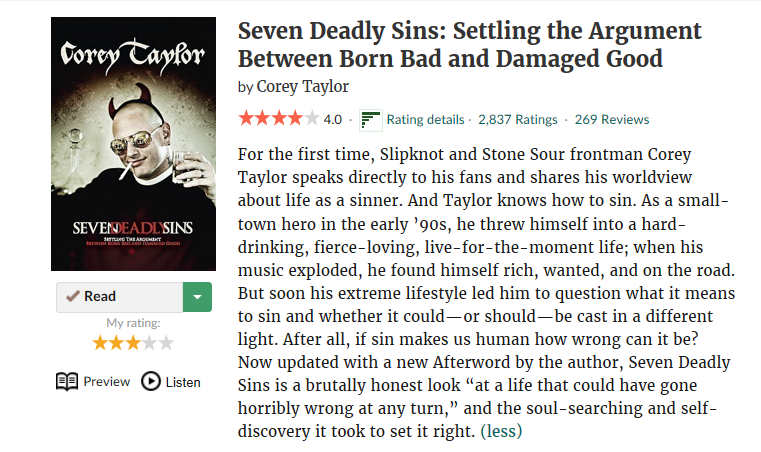
“I am not automatically doomed for being alive.”
– Taylor
Whew. What a mixed bag.
As a work that aspires to associate itself with philosophy, it falls short. The author did little to no formal research which is a shame only because his aim was so high. If an academic had been retained to help shape the philosophical content into something more robust, this work would have been sapiosexual erotica: A metal god introducing his fans to Blaise Pascal and WK Clifford the way he gave us his interpretation of thrash metal? I was so there for it.
I quickly found my expectations dashed on the rocky surf of my artistic hero’s limits. This ends up reading more like a first draft college midterm, but there is still a fuck ton of value to mine from it, whether you’re reading it with a critical eye or that of a fan willing to turn that eye blind with adoration.
The core failing of the book’s lofty intellectual ambition is this: It’s hard to engage in philosophy effectively if you don’t understand your opponent’s position inside and out. Corey didn’t seem interested in meeting those guys on their level, which is understandable if you have no respect for religious bullies, but his arguments falter because he doesn’t seem to fully understand what he’s arguing against. I mean, he knows what HE’S arguing against, it’s just not really the seven deadly sins.
With that out of the way, I still recommend it to fans.
“One of my philosophies has always been, ‘if you do not say it, it does not get said.’ Basically saying, it means if you want something in life, speak up or shut up.”
– Taylor
This is Corey’s voice bouncing around inside your skull in a way you’ve never felt before. From the silly digressions and irascible yet optimistic attitude to the aphorisms, insights, and wisdom acquired from an extraordinary life, he’s in there with the parts of himself that most of us keep hidden out of fear of the worst in each other. Most people with his history or public image would have closed themselves off and condemned humanity as doomed beyond repair.
At minimum, this book’s value is that it exists at all despite the adversity its author faced to reach a point where he could write and publish it. Yes, he has huge advantages now that made it possible, but he’s also had a journey of survival that he’s still working out, just like all of us had and are. That’s where he meets us. That’s where he puts a hand on our shoulders – as he’s always done as a musician and poet – and lets us know we’re not alone, and that we’re not doomed to drown under the worst we’ve ever faced, whether from the world or within ourselves.
He knew he didn’t have the academic chops to meet the invisible goals of unknown readers. He wrote it anyway. He needed to, for himself. And it turns out a lot of us needed it, too. That alone is an example and lesson worth the money and time I spent on reading this rambling, target-missing think piece: My artistic hero has limits like anyone. What makes him heroic is that he doesn’t let those limits stop him from aiming for glory.

 BLOG OF RHIANNIMATOR