Day 5 of NaPoWriMo and I’m a bit behind on my challenges. To catch up, I need to add or annotate two songs on Rock Genius.
Today being the 20 year anniversary of Kurt Cobain’s suicide, I thought I’d see if any Nirvana lyrics were left unannotated. Of course not. Certainly not “Heart-Shaped Box.”
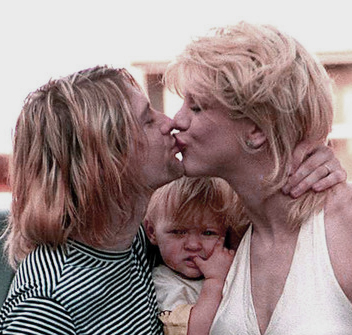
While the annotations are mostly solid, I disagree with about half of them. I think there’s too much focus on a negative view of Courtney Love, even elucidating lines 9 – 11 with, “Cobain killed himself in 1994. His volatile relationship with Love may have been a contributing factor.”
No shit.
I don’t know anything about his relationship with his wife, but when you’re depressed, your relationship with EVERYONE and EVERYTHING is a contributing factor. It’s bullshit to fixate on his marriage. I know it’s a tentative statement up there, with “may have been” and “contributing factor,” but it singles that issue out and unfairly brings it to the fore. Kurt was in a lot of pain and probably had been for most of his life. Depression makes you feel overwhelmed by every little thing ever, like you can’t handle any of it. Like the lightest feather falling onto the piled-up mess of your life will break you.
Now, the folks annotating these lyrics are more fanatical about Cobain and Nirvana than I ever was or ever will be. (At least I hope they are.) So I’m willing to concede if they have good footing on this next viewpoint I want to contest. The synopsis claims, “The first single from In Utero, Heart-Shaped Box details the battle of wills inherent to a new relationship when one doesn’t quite feel so strongly about another person.”
Okay, cool. I’ve never really sat down to think about what these lyrics mean, so that sounds like a great place to start. But then the annotations all skew towards Courtney being more in love with Kurt than he was with her (even suggesting in a roundabout way that she had emotionally blackmailed him into a relationship).
I don’t dig it. I think the opposite is more accurate. Here’s why.
She eyes me like a Pisces when I am weak
I’ve been locked inside your heart-shaped box for weeks (2)
I’ve been drawn into your magnet tar pit trap
I wish I could eat your cancer when you turn black (4)Hey! Wait! I got a new complaint
Forever in debt to your priceless advice (6)
Line 2 is where the primary annotator establishes this approach that the narrator (Kurt Cobain) does not reciprocate the affections of his subject (Courtney Love). I disagree because from the first line, Kurt establishes himself as sensitive. Not only is this tied into the word “Pisces” (which I’ll explain below), but he calls himself weak. As much as Kurt aspired towards feminism, I think he had internalized hurtful patriarchal ideas about what men are and are not, and saw his sensitivity not necessarily as feminine, but unbecoming for an adult. He described himself as a “simpleton who obviously would rather be an emasculated, infantile complain-ee.”
That sentiment from his suicide letter is foreshadowed in the chorus of this song (lines 5-6). Right after declaring his love in verse 1 (explained below), he interrupts the melancholy with, “Hey! Wait! I’ve got a new complaint!” Certainly a sarcastic retort many of us have used during an argument with a loved one who’s accused us of whining. Also, as the annotations to the Rock Genius entry note, Cobain felt the media painted him as a complainer, and this seems to be one of the themes that looped in his mind as he obsessed over what was wrong with him and what he could do to understand it and get better.
Additionally, “sensitive” was a word repeated throughout his final letter, with Kurt mocking himself as “The sad little, sensitive, unappreciative, Pisces, Jesus man.” Like many people, he ascribed certain personality traits to his stars, so in his own language, “Pisces” became a word for “overly-sensitive, wishy-washy dreamer” or whatever other stereotypes this sign has.
A person who is this sensitive is prone, by their own definition, to feeling things more deeply than others. Therefore, I believe the narrator feels more strongly about his subject than she does him, and this is the cause of the turmoil described throughout the song.
Originally titled “Heart Shaped Coffin“, the lyrics are permeated by the claustrophobic sensation of being buried alive under emotions the narrator finds oppressive. At some point, everyone’s been inconvenienced with an attraction to or affection for someone who doesn’t reciprocate. There’s a reason it’s called a “crush.” The third line really underscores this attraction with the words, “drawn” and “magnet,” but the image of the “tar pit trap” informs the listener that the narrator is mired in these feelings and can’t escape. Whatever got stuck in an ancient tar pit stayed there until it died. I see where people can infer emotional blackmail and abuse from this, but what I see instead is a narrator who knows he’s going to his grave completely in love with his subject. For better or worse.
Finally, line 4 has been described by biographer Charles Cross as “the most convoluted route any songwriter undertook in pop history to say ‘I love you'” (Heavier than Heaven, 2001). This line can be paraphrased as, “I wish I could take from you whatever’s bothering you, even if it hurts me.”
I don’t know how there are still people out there who think Courtney Love killed Kurt Cobain, or that he never really loved her, for that matter. I chalk it up to the widespread, unchecked misogyny that allows us to believe stereotypes about “evil females,” especially when they’re attached to our beloved male rock stars. Kurt called Courtney “a goddess of a wife who sweats ambition and empathy” and closed out his letter with the following post-script:
Frances and Courtney, I’ll be at your alter. Please keep going Courtney, for Frances. For her life, which will be so much happier without me. I LOVE YOU, I LOVE YOU!

 BLOG OF RHIANNIMATOR